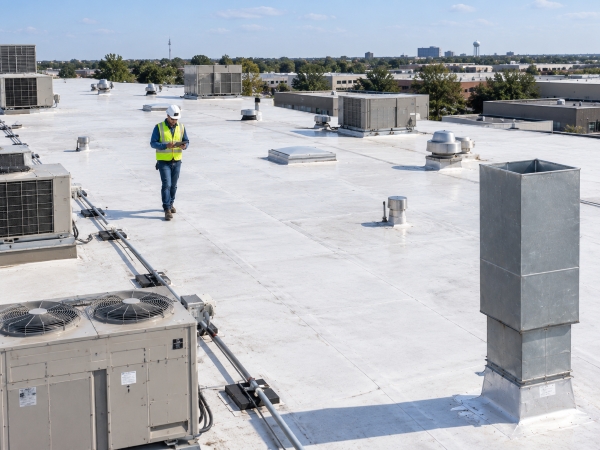
Many localized problems on a commercial TPO roof, including separated seams, small punctures and flashing defects, may be repairable when the surrounding membrane and roof assembly remain suitable for localized work. A.H. Sturgill Roofing has worked on commercial roofs since 1991, and this page explains how TPO roof repairs are typically done on Dayton, OH buildings and how to tell when repair stops being the right answer.
TPO is a single-ply thermoplastic membrane, and our TPO roofing page for Dayton covers how to decide whether the system suits a building. Repair is a separate question. TPO seams are commonly joined with hot-air welding, but the repair method still has to match the installed membrane, the defect, surface condition, flashing details, and any moisture found in the roof assembly. To have a roof looked at, call (937) 254-2955.
Common TPO Problems and How They Are Repaired
TPO comes in wide sheets that are joined at seams and turned up walls and curbs with flashing. Leaks can begin at seams, flashing, penetrations, damaged membrane, drains, or other details, so the repair should follow the confirmed defect rather than a general assumption. The table below pairs common defects with the repair approach generally used.
| Defect | Typical Repair | What Limits the Repair |
|---|---|---|
| Open or separated seam | Prepare the seam area and use a compatible repair method, which may include hot-air welding where the installed membrane and surface condition allow it | Seams that keep separating along a long run suggest a broader welding or aging problem |
| Puncture or small tear | Prepare the damaged area and install a compatible TPO patch sized and detailed for the defect and selected repair system | Many punctures in one area can mean the membrane is worn, or that foot traffic is a recurring cause |
| Failed flashing at walls or curbs | Repair or replace the affected flashing with materials and details compatible with the installed TPO system | Damaged walls, curbs or substrate may need to be corrected first |
| Leaking pipe or vent penetration | Repair or replace the penetration flashing using a compatible detail for the installed membrane | Cracked or movement-prone penetrations may need to be rebuilt |
| Loose membrane or backed-out fasteners | Evaluate the attachment and deck condition, then re-secure and cover the area with a compatible system if localized repair is appropriate | Widespread loosening can point to a deck or attachment problem |
Why Heat Welding and Surface Preparation Matter

TPO repair performance depends on compatible materials, surface preparation, and the quality of the finished seam or patch. Dirt, residue, weathering, or contamination can interfere with bonding, so the area should be prepared according to the repair-system requirements before welding or another approved method is used. The completed detail should then be checked for continuity.
Compatibility matters too. A patch or flashing that is incompatible with the membrane already installed may not bond or perform as intended. This is one reason it helps to know what product is on the roof, and why a crew that works with single-ply systems should be involved. Our single-ply roofing page explains how TPO, PVC and EPDM differ, and the repair method for an EPDM roof is different again, as described on our EPDM roof repair page.
Finding the Real Source of the Leak
On a membrane roof, water can enter in one place and become visible inside somewhere else because it can travel within parts of the roof assembly. A ceiling stain therefore does not prove the exact entry point. A sound repair starts by tracing the water back to its entry point, checking seams, flashing, penetrations and drains. Our commercial roof leak repair page for Dayton explains how to tell a localized leak from a wider problem, and the defects common to any flat roof are covered on our flat roof repair page.
Seams and flashing deserve close attention on TPO roofs. Seams and flashing deserve close attention because they connect membrane sections and transition the roof around walls, curbs, drains, and equipment. Temperature changes, movement, attachment conditions, and aging can affect those details, but a leak near a wall or curb still needs to be traced before the repair scope is set.
When a Patch Is Not Enough
Localized repair may fit when the defect is limited and the surrounding roof remains suitable for repair. A broader scope may need to be compared when moisture, attachment problems, seam failure, or membrane deterioration extend across larger areas. The table below shows the signs that usually separate the two.
| Signs Repair Is Reasonable | Signs a Larger Scope May Be Needed |
|---|---|
| A few isolated defects in otherwise sound membrane | New leaks keep appearing in different places |
| No confirmed widespread moisture or substrate deterioration in the area being evaluated | Confirmed moisture or deteriorated materials extend across broader areas |
| Most surrounding seams remain serviceable after inspection | Seam or attachment defects repeat across multiple roof areas |
| Existing membrane accepts the selected compatible repair method after preparation | Membrane condition or compatibility prevents a reliable localized repair |
A roof with repeated failures in the same or multiple areas deserves a broader assessment. Moisture, membrane condition, attachment, drainage, and compatibility should be evaluated before more spot repairs are approved. That assessment can help determine whether localized repair, restoration, or replacement should be compared, and our commercial roof inspections page explains how we approach it.
Keeping TPO Repairs From Coming Back
Recurring leaks can come from drainage, rooftop traffic, debris, attachment, flashing, or other conditions beyond the repaired spot. Ongoing inspection and maintenance can document changes in seams, flashing, drainage, and repair areas, and our roof maintenance page for Dayton describes what a routine looks like. After a repair, documentation of what was repaired and where can help future inspections compare the same area over time.
TPO Roof Repair in Dayton, OH
If your commercial building in Dayton, OH has a TPO roof that is leaking or showing wear, A.H. Sturgill Roofing can inspect it, explain what is causing the problem and recommend repair or a larger plan. Call (937) 254-2955 or contact our team.
Frequently Asked Questions
Can a leaking TPO roof be repaired instead of replaced?
Often, when the defect is localized and the surrounding membrane, insulation, attachment, and substrate remain suitable for repair. Inspection is needed to confirm the scope.
How are TPO seams repaired?
Separated seams may be repaired with hot-air welding or another compatible method, depending on the installed membrane, surface condition, and repair-system requirements.
Why does my TPO roof keep leaking after patching?
The visible leak location may not match the entry point, or the roof may have broader seam, attachment, moisture, drainage, or flashing conditions that spot repair alone cannot resolve.
How do I know when TPO repair is no longer worth it?
Repeated failures, broad seam or attachment problems, widespread moisture, or membrane conditions that prevent a reliable localized repair can justify comparing a larger scope.