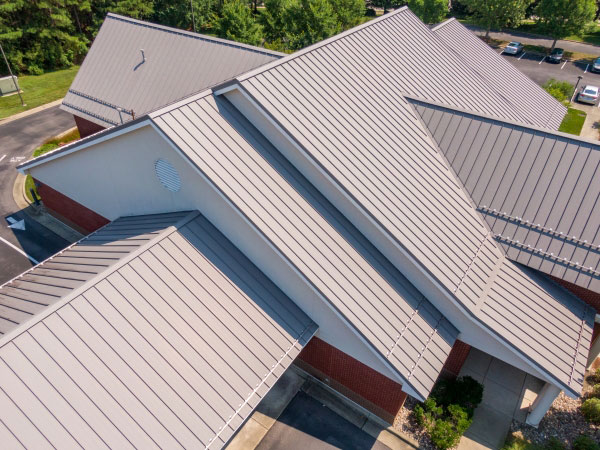
A standing seam metal roof can be a strong option for some commercial buildings in Xenia, OH, but it is not automatically a better choice than a low-slope membrane system. The right system depends on roof geometry, structural capacity, drainage, rooftop equipment, access needs, insulation strategy, project budget, and how the owner expects to use the building over time.
A.H. Sturgill Roofing confirms Standing Seam Metal Roof and TPO, PVC, and EPDM single-ply installation within its commercial service scope. That allows the system comparison to start with the building rather than forcing every project toward one roofing type.
Start With Roof Geometry and Drainage
Roof slope is one of the first design factors to review. Standing seam metal systems are used on sloped and some low-slope applications, but allowable slope depends on the specific panel system, seam design, manufacturer requirements, and project engineering. A low-slope commercial building may be a natural fit for a membrane system, but the roof should be evaluated before assuming either option is required.
Drainage matters with both systems. The design should account for roof slope, drains or gutters, penetrations, transitions, and locations where water or snow may collect. Converting an existing roof to a different geometry can also affect structure, flashing, equipment, and cost, so that decision needs a project-specific review.
Compare Structural and Attachment Requirements

Standing seam metal roofing and single-ply membranes transfer loads to the building in different ways. The roof deck, framing, insulation assembly, attachment method, perimeter and corner conditions, and local design requirements all influence the final system.
Wind resistance should not be treated as a simple metal-versus-membrane advantage. Properly designed systems in either category can be engineered for the required conditions. The important question is whether the proposed assembly, attachments, and details are appropriate for the building and supported by the project specifications.
Consider Rooftop Equipment and Future Access
Commercial roofs often carry HVAC equipment, vents, piping, skylights, and other penetrations. A building with frequent rooftop service needs may place different demands on walk paths, access routes, flashing, and future modifications than a building with relatively little rooftop traffic.
Standing seam metal can work well with rooftop equipment when penetrations and attachments are properly planned. Membrane systems can also accommodate complex low-slope layouts. Owners should compare how each option handles existing equipment, future additions, maintenance access, and the details required to keep penetrations watertight.
Look Beyond Initial Cost
Installation price is only one part of the decision. A useful comparison should include the expected maintenance approach, repair access, future modifications, insulation work, drainage changes, replacement planning, and any project-specific warranty requirements.
A standing seam metal system may involve different material and installation costs than a single-ply membrane system, but there is no universal cost relationship that applies to every building. Likewise, service life should not be reduced to one fixed number. Performance depends on system design, materials, installation, environment, maintenance, rooftop activity, and the conditions of the building.
Review Energy Performance as a Whole-Roof Decision
Energy performance depends on more than the exposed roofing material. Insulation levels, air and vapor control, roof color and reflectance, thermal bridges, rooftop equipment, building use, and HVAC operation can all affect the result.
That means neither standing seam metal nor a membrane roof should be described as automatically more energy efficient. Owners should compare the complete proposed assemblies and any documented energy-performance information that applies to the actual materials and design.
Plan for Snow, Rain, and Seasonal Movement
Ohio weather exposes commercial roofs to rain, snow, wind, sunlight, and repeated temperature changes. Standing seam metal panels are designed to accommodate thermal movement through system-specific seams, clips, or attachment details. Membrane systems also need properly designed seams, flashing, attachment, and drainage to perform through seasonal movement.
Snow behavior can vary with slope, surface, roof shape, rooftop equipment, and local conditions. A sloped metal roof may shed snow differently from a low-slope membrane roof, but snow shedding is not always an advantage because falling snow and ice can create hazards near entrances, sidewalks, equipment, or lower roof areas. Those conditions should be addressed in the design.
Use the Existing Roof Condition to Guide the Decision
If the project involves an existing building, the current roof and structure need to be understood before selecting a replacement system. A professional commercial roof inspection can help document roof condition, drainage, penetrations, previous repairs, and other conditions that may affect the new scope.
Owners who are comparing long-term capital needs can also use a roof asset management approach to organize repair history, maintenance needs, and future replacement planning. That information can make the metal-versus-membrane comparison more useful than relying on material preference alone.
Standing Seam Metal Roof Decisions in Xenia, OH
A.H. Sturgill Roofing serves commercial building owners in Xenia, OH and confirms both Standing Seam Metal Roof and TPO, PVC, and EPDM single-ply installation in its commercial service scope. The best choice should reflect the building’s roof geometry, structure, drainage, equipment, access needs, insulation plan, and ownership goals.
If you are comparing standing seam metal with a membrane system, contact A.H. Sturgill Roofing or call (937) 254-2955 to discuss an on-site evaluation and system options for the building.
Frequently Asked Questions
Can a low-slope commercial roof use standing seam metal?
Some standing seam systems are designed for low-slope applications, but suitability depends on the specific panel system, slope, detailing, structure, and project requirements.
Is standing seam metal always more durable than a membrane roof?
No single service-life claim fits every project. Durability depends on the system design, installation, environment, maintenance, and building conditions.
Which system is better around rooftop HVAC equipment?
Either system can be designed around rooftop equipment. The better fit depends on access needs, penetrations, flashing details, future modifications, and roof geometry.
Which roof system is more energy efficient?
Energy performance depends on the complete roof assembly and building, including insulation, air control, reflectance, thermal bridges, and HVAC operation.