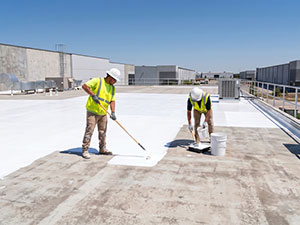
Commercial buildings in Beavercreek face heavy spring rain, summer humidity, and recurring freeze-thaw cycles that stress flat roof connections. Water can travel within the roof assembly before becoming visible indoors, making the source of a leak difficult to locate. Flat roof sealing addresses vulnerable details to help reduce the risk of water intrusion.
Call A.H. Sturgill Roofing at (937) 254-2955 for flat roof sealing in Beavercreek, OH.
How Flat Roof Sealing Protects Commercial Buildings
Understanding where sealing helps and where more extensive repairs are needed can help property owners choose an appropriate repair approach.
Where Flat Roofs Break Down

Many flat roof leaks begin at a few common locations. Membrane seams are frequent trouble spots because joining two sheets of roofing material creates a bond that must withstand years of thermal expansion and contraction. As that bond weakens, gaps can form. Even a narrow separation may allow water to migrate beneath the membrane and into the insulation below.
Flashing around walls, curbs, drains, and penetrations also requires attention. Repeated thermal movement can contribute to separation and create paths for water. At pipes, conduits, and HVAC curbs, compatible flashing and sealant work together to protect transitions. Cracked sealant or damaged flashing can compromise these details. Drain connections are also vulnerable because standing water can prolong exposure at the membrane-to-drain connection.
How Sealing and Related Repairs Address Damage
Targeted sealing addresses specific roof details rather than covering the entire surface. The repair method must match the membrane and the defect. Sealant may be appropriate at designated joints, but open membrane seams can require repairs beyond surface sealant, such as a compatible patch or renewed seam connection.
At flashing terminations and penetrations, a roofing professional cleans and prepares the surface before applying compatible sealant where the roof detail requires it. Damaged or separated flashing may need repair or replacement. Drain connections also require an appropriate repair detail; sealing alone does not correct blocked drainage or inadequate roof slope.
When Sealing Is the Right Repair
Sealing is most effective when the surrounding roofing materials are sound and the problem is limited to a detail that can be repaired with sealant. A roof with dry insulation, a sound deck, and an intact membrane may be a candidate for localized repairs. An inspection helps determine whether targeted work is sufficient or broader restoration or replacement is needed.
When the membrane has deteriorated, the insulation is saturated, or the deck is damaged, sealing alone will not correct the underlying condition. A professional inspection can determine the extent of the damage and the appropriate solution. Beavercreek property owners who address problems while the membrane remains viable may avoid the higher costs associated with widespread roof failure.
Flat Roof Sealing in Beavercreek
Addressing deteriorated seams, flashing, penetrations, and drain connections can help protect a commercial roofing system from water damage. For flat roof sealing in Beavercreek, OH, contact A.H. Sturgill Roofing at (937) 254-2955 today.
FAQ
What areas of a flat commercial roof need sealing most urgently?
Seams, flashing, penetrations, and drain perimeters deserve close attention because deteriorated connections can allow water entry. An inspection determines which areas need urgent work and whether sealing or another repair method is appropriate.
How long does flat roof sealing last before it needs to be redone?
Service life depends on the sealant product, surface preparation, installation quality, and weather exposure. A professionally applied sealant on a properly prepared surface may perform for several years. Periodic inspections can identify areas that need attention or reapplication before leaks develop.
Is sealing enough if water is already getting in?
It depends on the source and extent of the moisture. A localized defect may be repairable when the surrounding roofing materials remain sound, but the repair must match the membrane and damaged detail. Saturated insulation or a compromised deck requires further evaluation and may need more extensive work.