A commercial roof repair in Kettering, OH should begin with evidence about where the defect is, how far the problem extends, and what the proposed repair will actually address. A.H. Sturgill Roofing has more than 30 years of commercial roofing experience and serves Kettering businesses. Call (937) 254-2955 to discuss the roof and the symptoms you are seeing.
This article focuses on the commercial roof repair process itself: inspection, scope, access, repair work, closeout, and the point where a localized repair should give way to a broader roof assessment. If the building has an active leak, A.H. Sturgill Roofing’s Kettering commercial roof leak repair page covers that immediate leak-response question separately.
Understanding the Commercial Roof Repairs Process
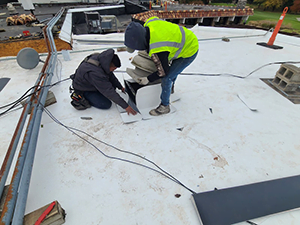
The process starts with an inspection of the roof and relevant interior symptoms. A.H. Sturgill Roofing’s published process includes reviewing visible roof damage, leaks, seams, flashing, penetrations, and other potential problem areas. Interior staining or dripping can help identify where closer investigation is needed, but the visible stain does not prove the roof entry point or the extent of concealed moisture.

The inspection should document what was found, where it was found, and what remains uncertain. When the available evidence supports a limited defect, the next step may be a localized repair. When similar defects appear in several areas, repairs keep failing, or moisture may extend beyond the visible problem, additional assessment may be needed before the scope is finalized.
Repair or Broader Assessment?
The table below shows how common findings can affect the next step. It is a decision aid, not a diagnosis. Actual repairability depends on the roof system, surrounding materials, moisture conditions, and the inspection evidence.
| Area | Evidence That May Support a Localized Repair | Evidence That May Require Broader Assessment |
|---|---|---|
| Seams | One limited seam defect with surrounding material still serviceable | Repeated separation across several areas or a seam that fails again after repair |
| Penetrations | One flashing or seal defect at a vent, curb, pipe, or drain | Several penetration details failing or deterioration extending beyond one detail |
| Flashing | A limited defect at one wall, edge, curb, or transition | Repeated flashing failure along a longer section or at multiple details |
| Moisture | Available evidence remains consistent with a limited entry point and surrounding materials appear serviceable | Evidence suggests moisture may extend into insulation, decking, or more than one roof area and requires additional investigation |
What a Repair Scope Should Explain
A repair proposal should identify the area being addressed, the repair method, compatible materials where applicable, access assumptions, and important exclusions. It should also explain what would trigger a change in scope. If concealed deck or insulation conditions are discovered after the work area is opened, the contractor should document the finding and explain the additional work before proceeding beyond the agreed scope.
Localized repair is not a promise that every nearby condition has been corrected. A patch, seam repair, flashing repair, or membrane repair addresses the defined defect. Widespread deterioration, repeated leaks, or suspected moisture beyond that area may justify a broader roof inspection in Kettering before more repair spending is authorized.
Access, Safety, and Building Operations
Roof access should be handled by trained roofing personnel. Building staff can document interior stains, drips, or recurring symptoms from safe locations, but they should not walk the roof to diagnose the problem. Before work starts, discuss how the crew will access the roof, where materials and tools will be staged, whether interior access is needed, and how entrances, employees, tenants, equipment, or normal operations will be coordinated when relevant.
A.H. Sturgill Roofing’s published process also describes safety measures such as barriers, personal protective equipment, and securing tools and equipment. The exact setup depends on the building and repair area, so those measures should be planned for the project rather than assumed to look the same on every site.
After the Repair
After the defined repair is completed, the repaired area should be reviewed against the agreed scope. Depending on the project, closeout may include checking repaired seams, flashing, sealing, or other details and documenting completed work. Before-and-after photos or other records can be useful when they are part of the project documentation, but they should not be assumed unless the scope says they will be provided.
Ongoing care should be based on the roof condition, repair history, rooftop activity, and any written maintenance requirements. A.H. Sturgill Roofing’s roof maintenance page for Kettering covers that separate planning step.
Commercial Roof Repairs in Kettering, OH
If your commercial or industrial building in Kettering needs roof repair, A.H. Sturgill Roofing can inspect the roof and explain whether the evidence supports a localized repair or a broader assessment. Contact the team or call (937) 254-2955 to discuss the building.
Frequently Asked Questions
How can I tell whether my roof needs a localized repair or a broader assessment?
A localized repair may fit when one defect is identified and surrounding materials remain serviceable. Repeated failures, several affected areas, or evidence that moisture may extend beyond the visible problem can justify broader assessment.
Does a ceiling stain prove there is hidden roof damage?
No. A stain shows that water reached the interior, but it does not identify the exact entry point or the extent of concealed moisture.
What should a commercial roof repair quote include?
It should identify the repair area, proposed work, access assumptions, important exclusions, and the conditions that would require additional investigation or a change in scope.
Can building staff inspect the roof before calling a contractor?
Staff can document interior symptoms from safe locations. Roof-level inspection should be left to trained roofing personnel because of fall hazards and the risk of damaging roof materials or disturbing useful evidence.